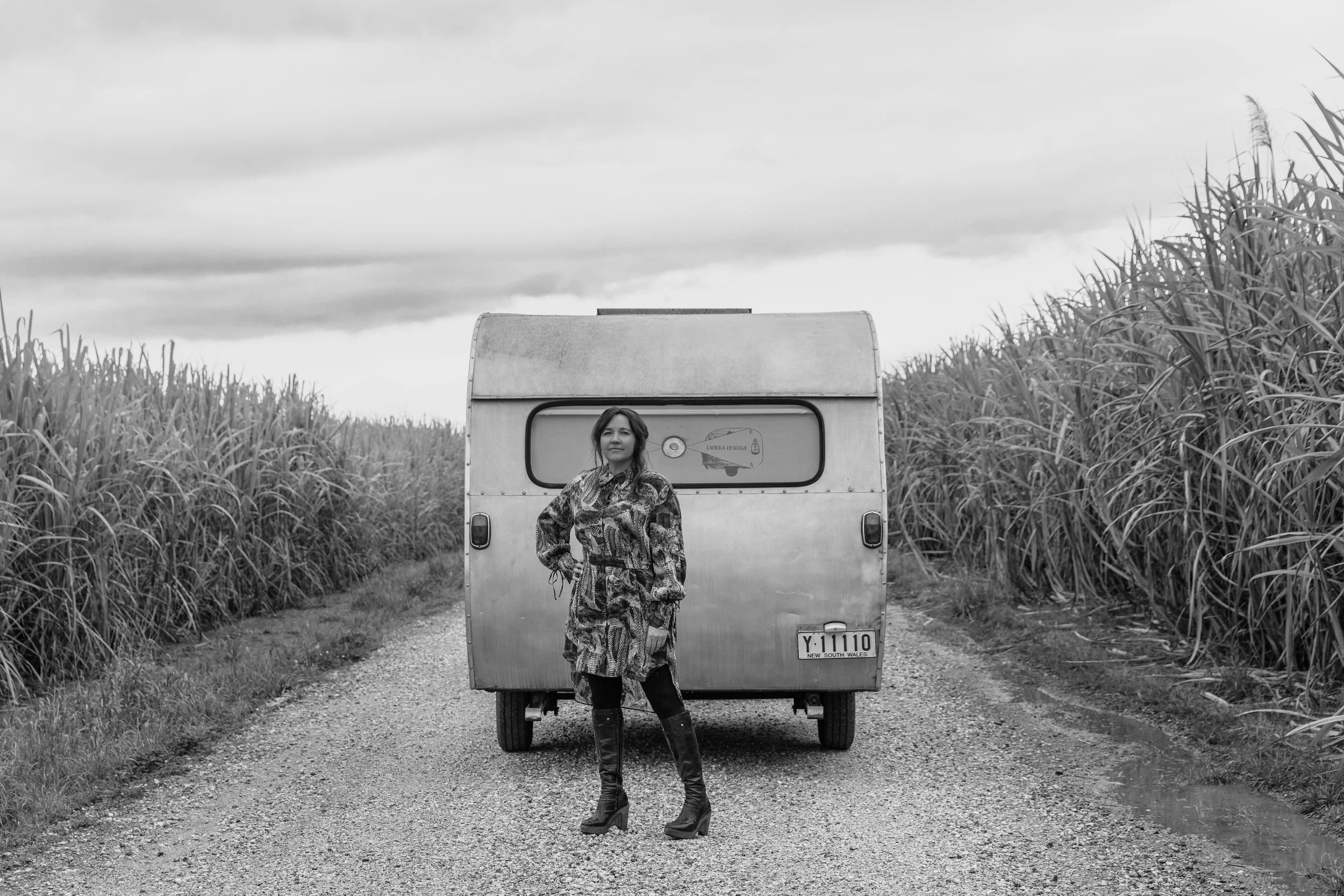
Claire Conroy is an Australian photographic artist whose practice explores the material and transformative possibilities of image-making. Working primarily with analogue, lensless and camera-less photographic processes, she constructs images through experimentation with light, photographic paper, found materials and handmade devices.
Conroy has constructed large-scale camera obscura and pinhole cameras from everyday objects, including a 1950s caravan, a water tank and a three-tonne truck. Her work engages with feminism, the environment, and political and emotional landscapes within contemporary life, using photography, installation, images and objects as ways of responding to the world around her, transforming experiences, impressions and observations into artworks.
Increasingly, Conroy’s practice is concerned with the relationship between the photographer, the subject and the act of making. She is interested in discovering how an image can emerge through an encounter with a person or place, and how personal experiences, stories and gestures of person and place can be materialised and translated into visual form.
This approach extends her longstanding interest in material experimentation. Contact printing, photograms, collage, fabrics, found objects and mark-making become ways of layering photographic images and incorporating traces of the people, places and experiences involved in their making. The resulting works sit between portrait, landscape, document and constructed image.
Conroy’s work is held in the collections of the NSW State Library, National Gallery of Australia and Powerhouse Museum, as well as private collections across Australia. She lives and works in Northern NSW, Australia.